I remember the first time I stood in front of one of Zoë Elena Moldenhauer’s map-like abstractions. It was a large square panel covered in geometric paper shapes. On top, she had scrawled notes and strange symbols, applied buttons and zippers, and wound colored thread from one paint blob to another. Inscrutable runic figures framed the piece, giving the impression of a kind of game board. I didn’t know the rules. And although I could see I was being offered a way forward, I couldn’t follow. In fact, the harder I tried, the more lost I felt. I stayed for a long time and let this peculiar sensation wash over me.
Imperialism seeks to erase language. Not only native tongues, but also the words needed to clearly retrace one’s own path through the interwoven histories of conquest, transatlantic slavery and migration. When Zoë, an adoptee of Guatemalan ancestry, couldn’t find the words to answer the essential human question—Who exactly am I?—she set out to make her own.
Zoë began by studying Nahuatl (an Aztec/Mexica language) and connecting with others similarly curious about their genealogy. She traveled to the Nazca geoglyphs in Peru and to cave painting sites in Brazil. Working in response to these encounters, a secret alphabet began to emerge, one that allowed her to piece together a story about her place in the world. Figure by figure, she developed a rich visual lexicon that offered a new kind of access to her past, present, and future.
On a research trip to Serra da Capivara in Brazil, Zoë encountered a place where history itself is disputed: Human remains once thought to confirm the Bering Strait migration theory have since been re-dated far earlier, reopening questions about when and how South America’s first peoples arrived. In her first solo exhibition, pegadas (“footprints” in Portuguese), Zoë brings us along on this uncertain path toward a new kind of self-knowledge.
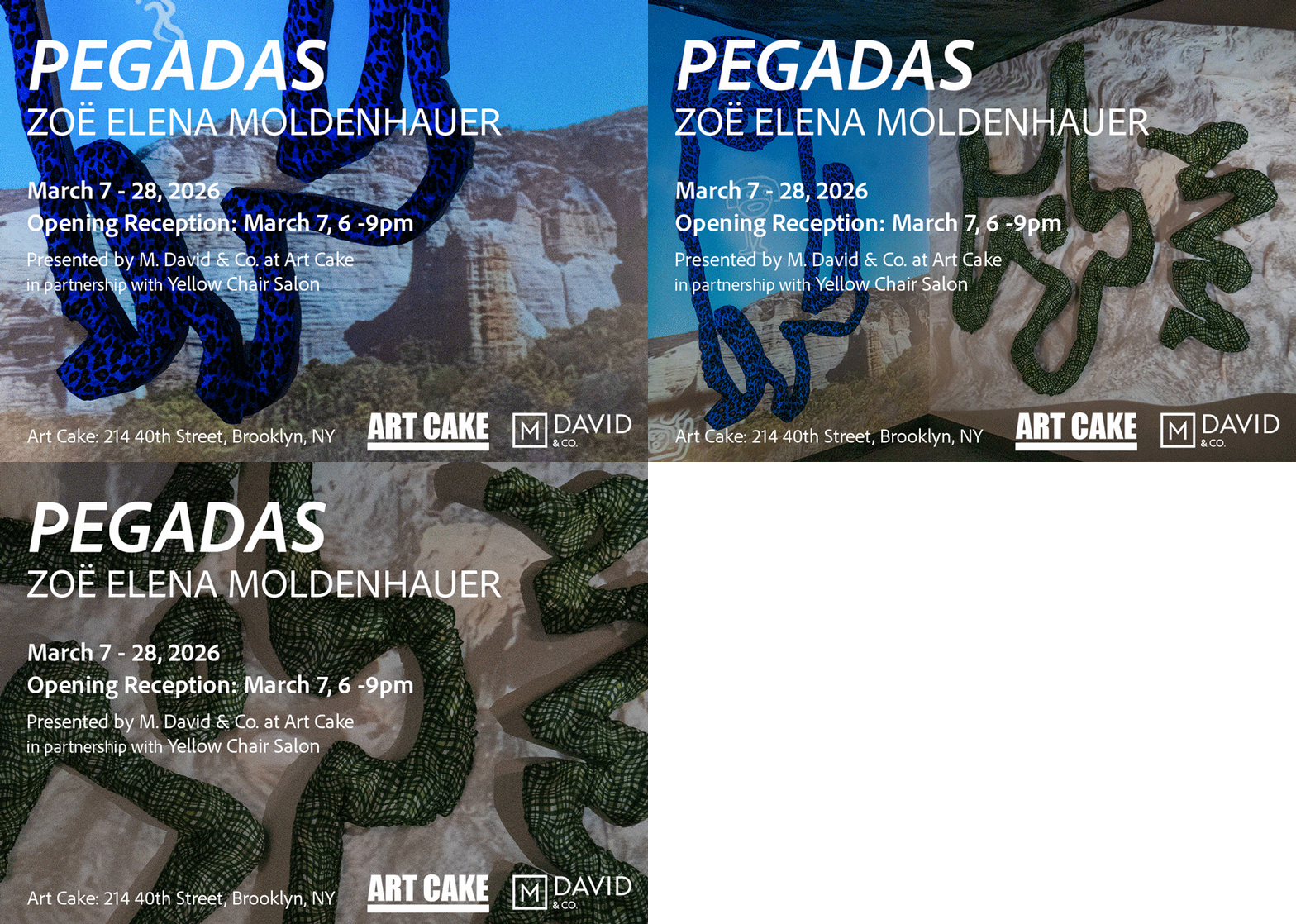
In pegadas, photographic wall projections situate us in dangerous but beautiful territory: epic canyons, craggy cave walls and rocky riverbeds. Life-sized soft sculptures stand sentinel, figures Zoë calls Tlapixqui (“guardians” in Nahuatl). This is her homemade alphabet writ large. They’re rendered in bright fabrics with vibrant, modern patterns which, under the hazy light of the projections, seem to flicker in and out of time.
Wandering among these strange souls, I feel lost again. There still isn’t a clear path forward. But the difference this time is that I feel welcomed by these guardians. They don’t seem eager to send me on my way. What once functioned as a private system of navigation becomes a shared experience—one where getting lost is not a failure, but an opening.
Exhibition text by Patrick Bower, a multidisciplinary artist living and working in New York City.
Zoë Elena Moldenhauer is a Guatemalan-born, New York City-based artist. In 2017, she created a fictional alphabet that draws from her transracial adoption, absent heritage, and Western upbringing. Combining multimedia with Nahuatl, the Nazca geoglyphs and cave paintings from Brazil Zoë uses her alphabet as a tool to create identity and research her ancestry. She received a BFA from the Maryland Institute College of Art in 2019 and an MA from New York University in 2022. She is the founder of The Aerogramme Center for Arts and Culture—an online platform providing opportunities to artists and writers founded in March 2020. Zoë resides in New York where she has a studio at Brooklyn Art Cluster and is an Amos Eno Gallery Community Member.
pegadas
Presented by M. David & Co. at Art Cake in partnership with Yellow Chair Salon
March 7 - March 28, 2026
Opening reception: Saturday, March 7, 6-9 pm
Gallery B
Art Cake: 214 40th Street, Brooklyn, NY 11232
Hours: Friday & Saturday, 1-6 pm and by appointment
We are pleased to present pegadas, a solo exhibition of recent works by Zoë Elena Moldenhauer at Art Cake in conjunction with her participation in the Yellow Chair Independent Study Program (ISP).