Exhibitions

Through our partnerships with M. David & Co. and ArtCake, Yellow Chair Salon offers ongoing exhibition opportunities for artists in Symposia!, Salon, the Independent Study Program, and PODS throughout the year. Providing artists with meaningful opportunities to present their work publicly is central to our mission.

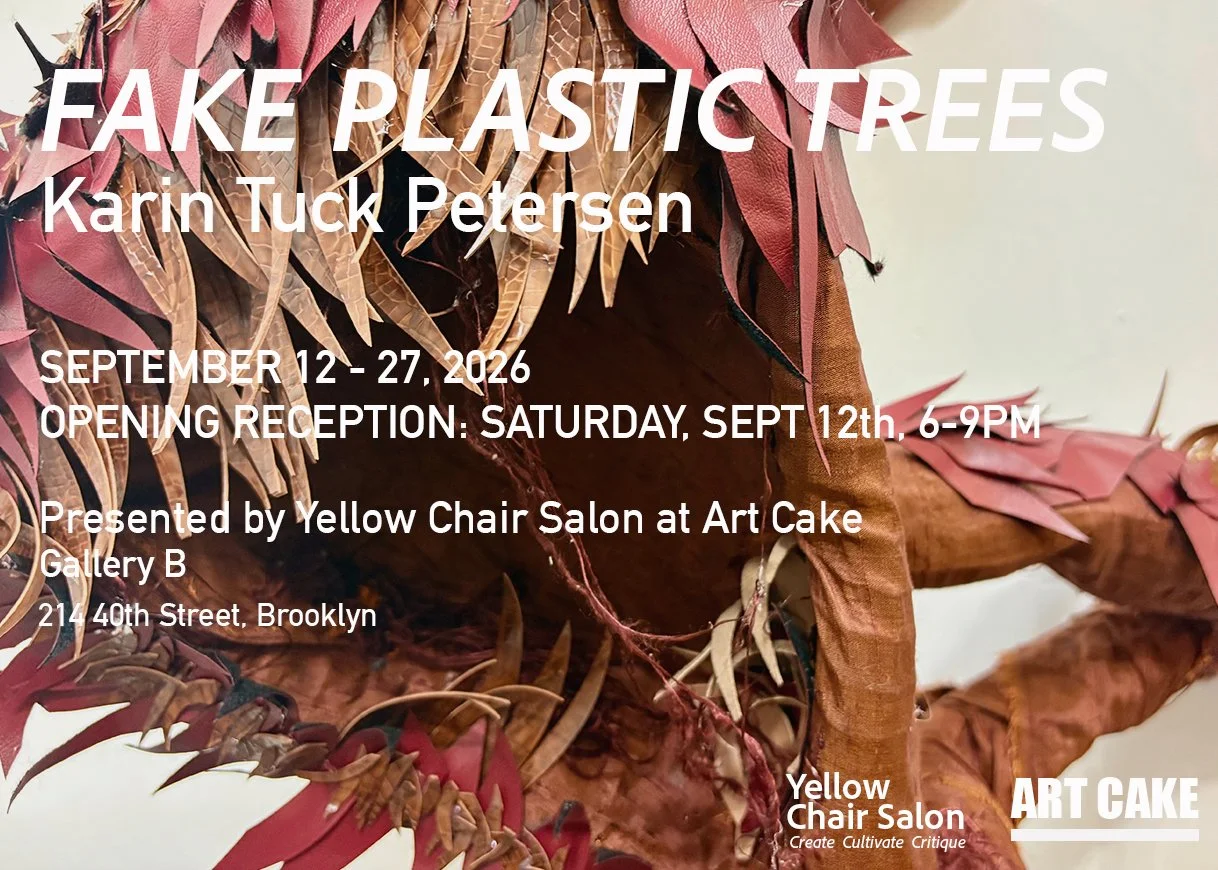
I remember the first time I stood in front of one of Zoë Elena Moldenhauer’s map-like abstractions. It was a large square panel covered in geometric paper shapes. On top, she had scrawled notes and strange symbols, applied buttons and zippers, and wound colored thread from one paint blob to another. Inscrutable runic figures framed the piece, giving the impression of a kind of game board. I didn’t know the rules. And although I could see I was being offered a way forward, I couldn’t follow. In fact, the harder I tried, the more lost I felt. I stayed for a long time and let this peculiar sensation wash over me.

Imperialism seeks to erase language. Not only native tongues, but also the words needed to clearly retrace one’s own path through the interwoven histories of conquest, transatlantic slavery and migration. When Zoë, an adoptee of Guatemalan ancestry, couldn’t find the words to answer the essential human question—Who exactly am I?—she set out to make her own.

Zoë began by studying Nahuatl (an Aztec/Mexica language) and connecting with others similarly curious about their genealogy. She traveled to the Nazca geoglyphs in Peru and to cave painting sites in Brazil. Working in response to these encounters, a secret alphabet began to emerge, one that allowed her to piece together a story about her place in the world. Figure by figure, she developed a rich visual lexicon that offered a new kind of access to her past, present, and future.


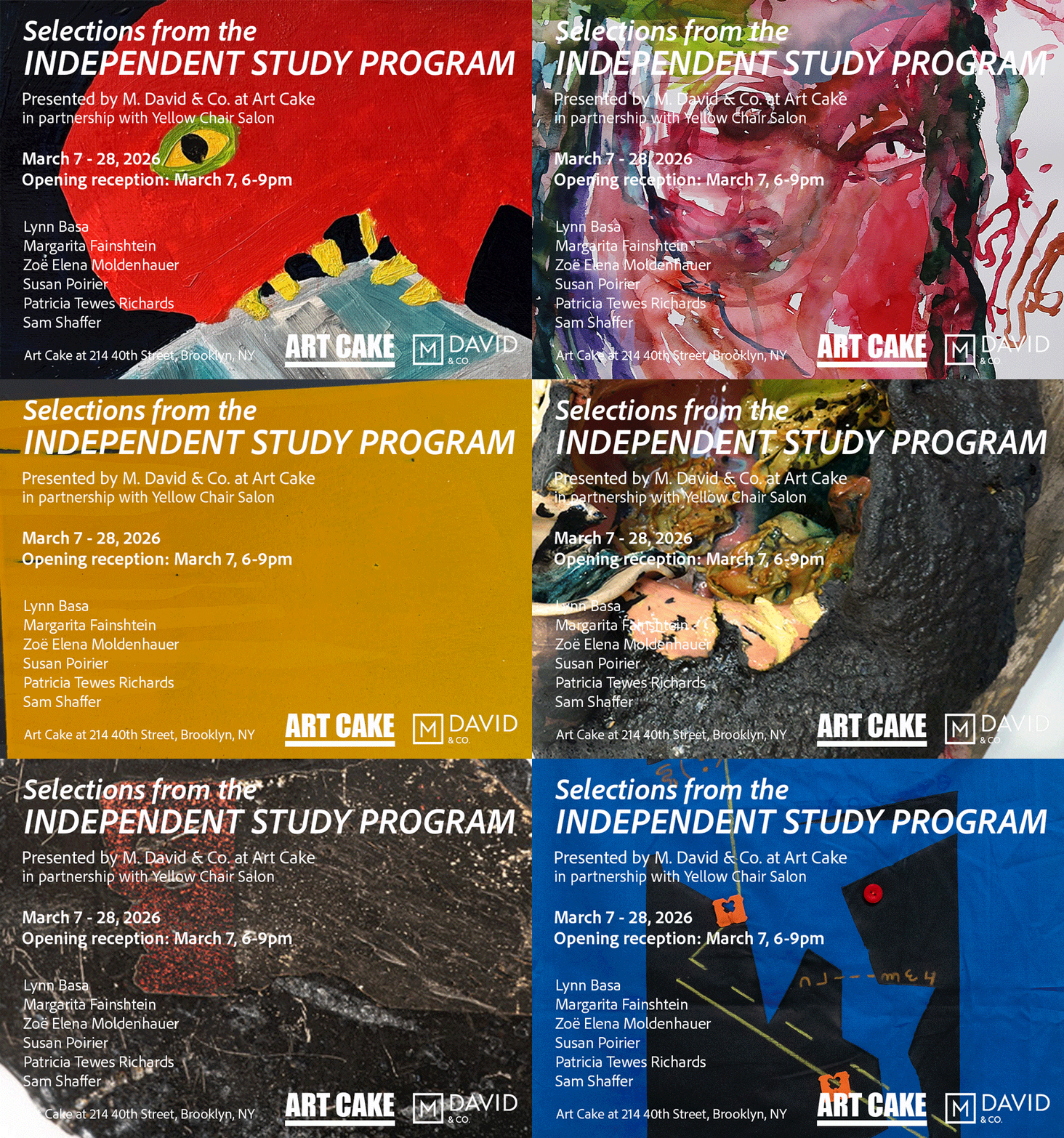
Red background with event information about an art exhibition titled 'Selections from the Independent Study Program.' It features a painted eye and footprints, and details about dates, artists, and location in Brooklyn, NY.

We are thrilled to present a selection of works by members of the Yellow Chair Independent Study Program (ISP) in partnership with Yellow Chair Salon.

This exhibition brings together six artists whose practices explore a range of materials and conceptual approaches. Featuring works by Lynn Basa, Margarita Fainshtein, Elena Moldenhauer, Susan Poirier, Patricia Tewes Richards and Sam Shaffer, we are proud to support the diverse practices of these exciting artists.


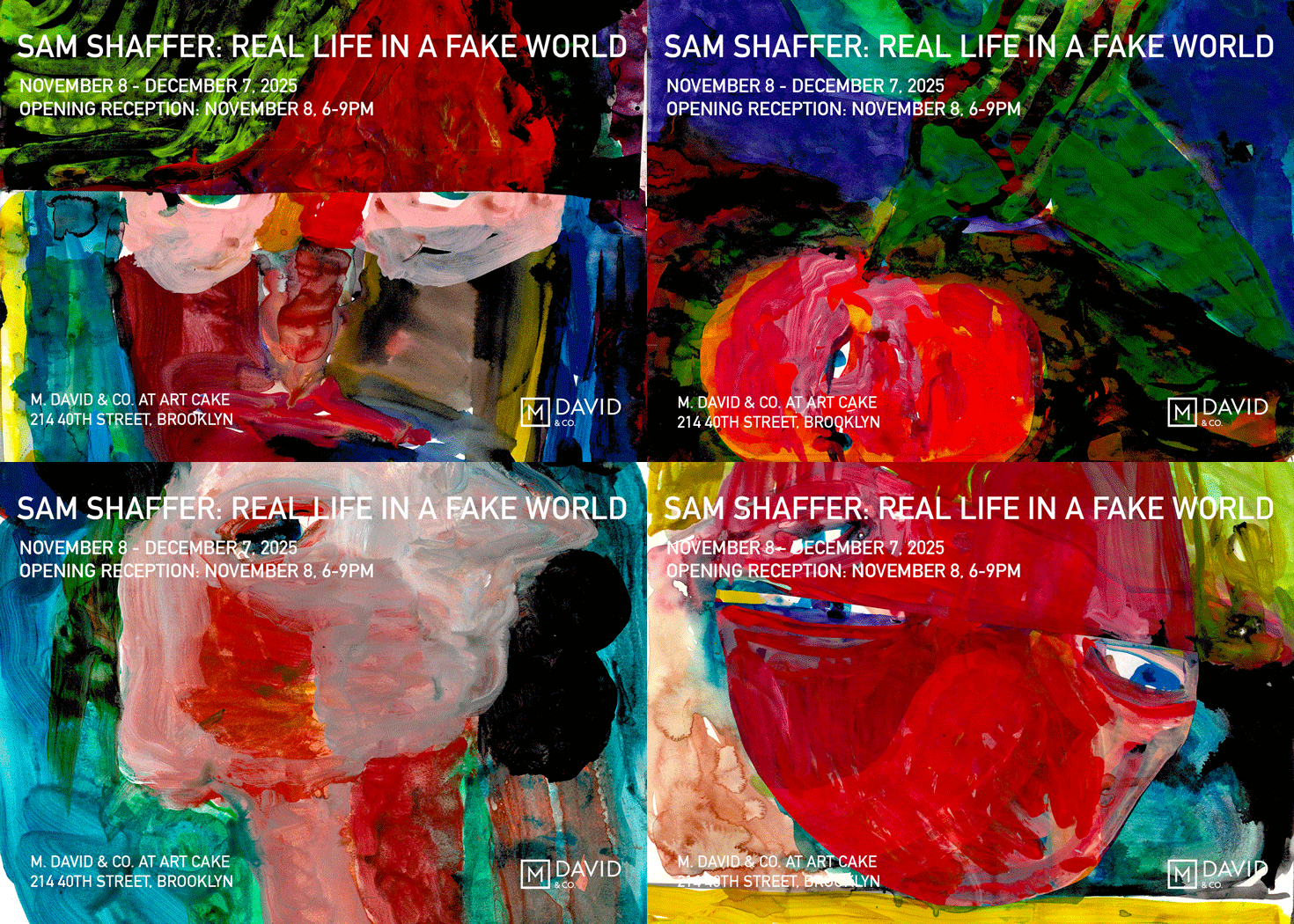
M. David & Co. is delighted to present Real Life in a Fake World, a solo exhibition of mixed media works on paper by Sam Shaffer. This marks the artist’s first solo exhibition with the gallery and his debut solo show in New York City.

Sam Shaffer is a painter working in a range of media and approaches to abstract imagery and subtle narratives. He is also a prolific maker of drawings and works on paper, which constitute a crucial element in the artist’s studio practice in a broader sense. Featuring scores upon scores of character and setting studies, standalone drawings, and other recent works on paper, Real Life in a Fake World is both an acknowledgment of the fundamentality of these works for Shaffer, and a vibrant celebration of their dreamy mystery and gestural vitality.

Working in mostly fluid materials such as watercolor, ink, and gouache in his drawings and works on paper, Shaffer creates abstract visions of figures, animals, hybrid beings, and features of the natural world, often in manners sympathetically inflected to lure viewers into attributing narratives to their environs. They perceive bizarre birds and more bizarre bird-people, various seafaring vessels and vast open seas, salty seafarers and mythical creatures, blazing suns and luminous starbursts, and much besides. Shaffer’s works harbor a sense of freedom and flow as well as focus, yielding imagery suggestive of meandering dreams and moments of startling urgency.


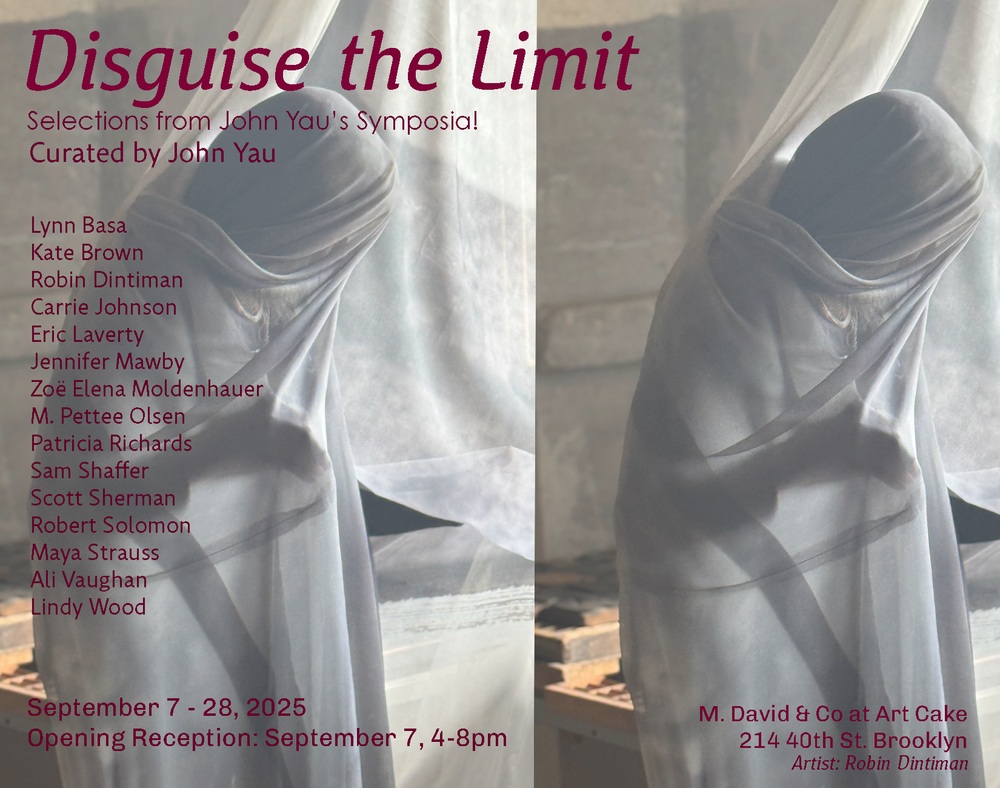
Event poster for art exhibition titled 'Disguise the Limit' featuring selections from John Yau's Symposia, curated by John Yau. The poster lists artists including Lynn Basa, Kate Brown, Robin Dintiman, Carrie Johnson, Eric Laverty, Jennifer Mawby, Zoe Elena Moldenhauer, M. Pettee Olsen, Patricia Richards, Sam Shaffer, Scott Sherman, Robert Solomon, Maya Strauss, Ali Vaughan, and Lindy Wood. The exhibition runs from September 7 to 28, 2025, with an opening reception on September 7 from 4 to 8 pm, at M. David & Co at Art Cake, 214 40th St., Brooklyn. The artist is Robin Dintiman.

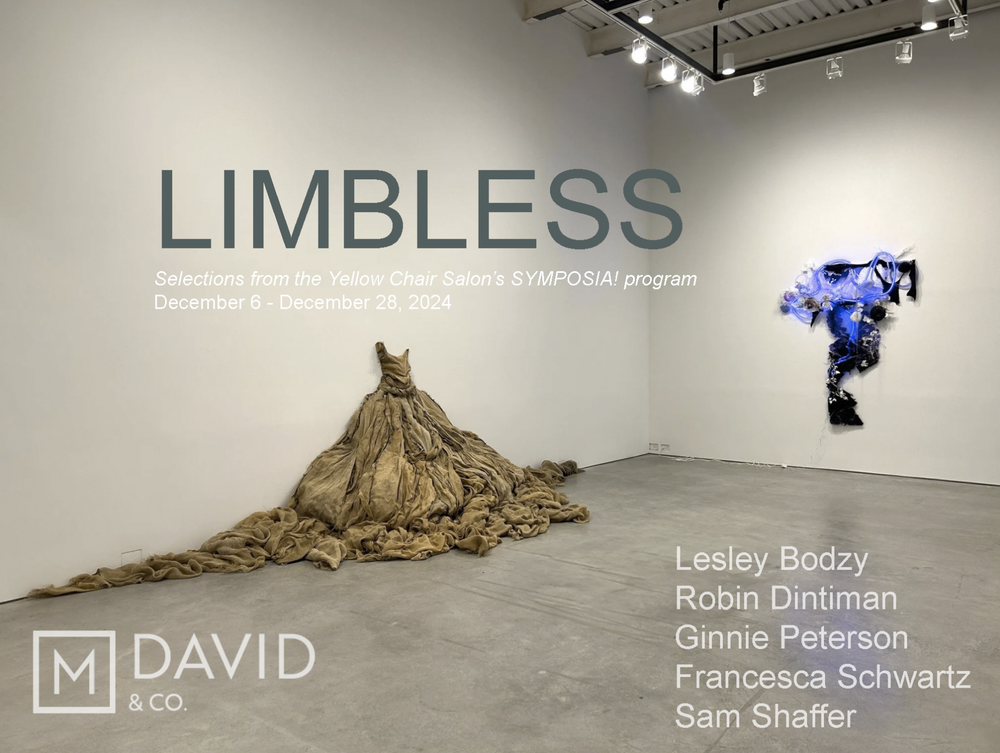
Limbless: Selections from the Yellow Chair Salon’s Symposia! program
Featuring work by Lesley Bodzy, Robin Dintiman, Ginnie Peterson, Francesca Schwartz, and Sam Shaffer

Photo of an art gallery wall with text overlay promoting an exhibition called 'LIMBLESS'. The exhibition features selections from the Yellow Chair Salon's SYMPOSIA! program, running from December 6 to December 28, 2024. The wall displays two sculptures: a large, draped fabric piece resembling a reclining figure or creature on the left, and an abstract art piece with blue, purple, and black elements on the right. The gallery has a minimalist design with light-colored walls and ceiling-mounted lighting.
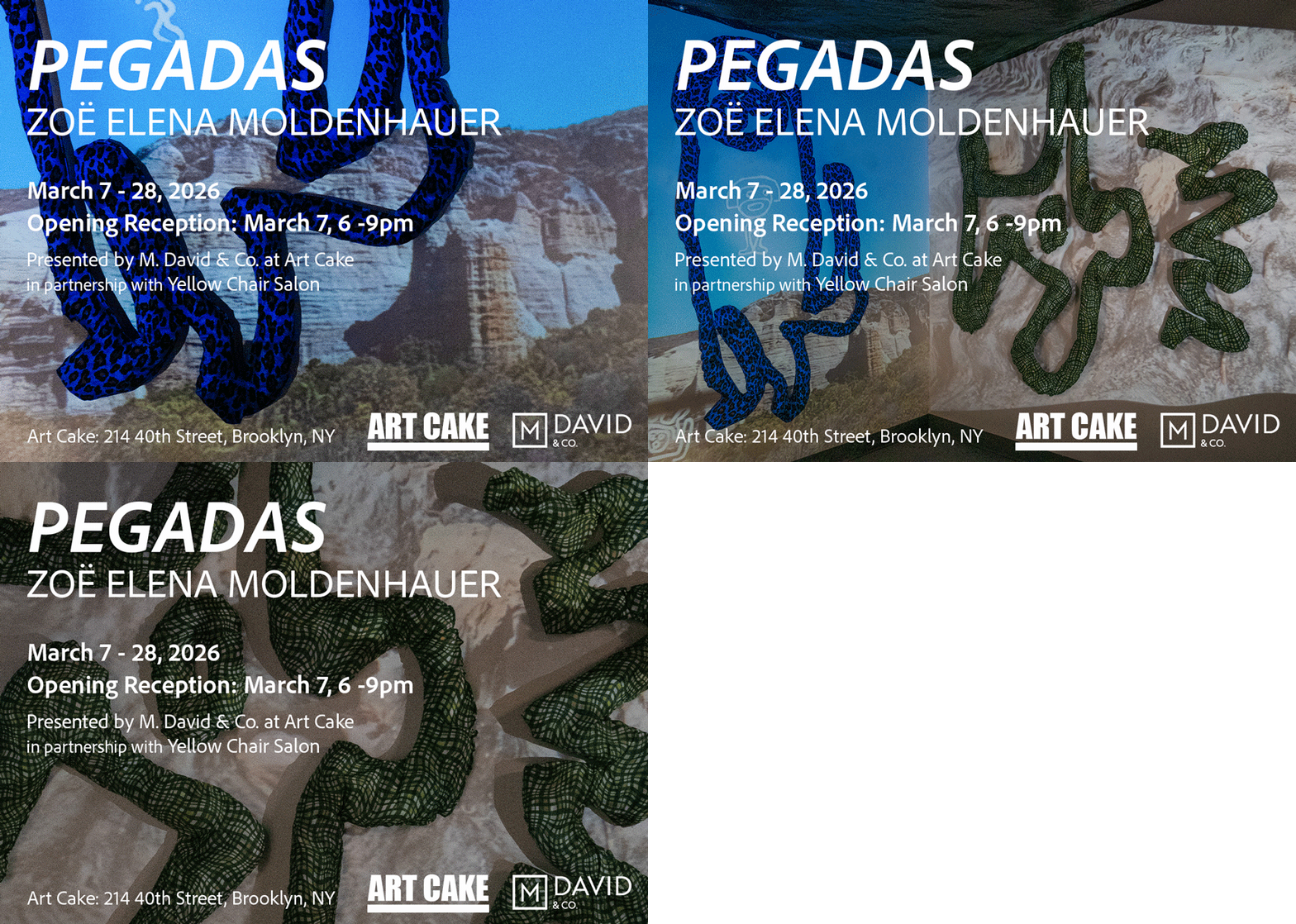
Event poster for an art exhibition titled "Pegadas" by Zoë Elena Moldenhauer, held from March 7 to March 28, 2026, with an opening reception on March 7, 6 to 9pm, presented by M. David & Co. at Art Cake, located at 214 40th Street, Brooklyn, NY. The poster features a background with rocky landscape and a large, stylized blue and black animal print snake.

On a research trip to Serra da Capivara in Brazil, Zoë encountered a place where history itself is disputed: Human remains once thought to confirm the Bering Strait migration theory have since been re-dated far earlier, reopening questions about when and how South America’s first peoples arrived. In her first solo exhibition, pegadas (“footprints” in Portuguese), Zoë brings us along on this uncertain path toward a new kind of self-knowledge.

In pegadas, photographic wall projections situate us in dangerous but beautiful territory: epic canyons, craggy cave walls and rocky riverbeds. Life-sized soft sculptures stand sentinel, figures Zoë calls Tlapixqui (“guardians” in Nahuatl). This is her homemade alphabet writ large. They’re rendered in bright fabrics with vibrant, modern patterns which, under the hazy light of the projections, seem to flicker in and out of time. 

Wandering among these strange souls, I feel lost again. There still isn’t a clear path forward. But the difference this time is that I feel welcomed by these guardians. They don’t seem eager to send me on my way. What once functioned as a private system of navigation becomes a shared experience—one where getting lost is not a failure, but an opening.

Exhibition text by Patrick Bower, a multidisciplinary artist living and working in New York City.

Art exhibition flyer featuring colorful, abstract, puppet-like characters promoting Sam Shaffer's art show titled 'Real Life in a Fake World' from November 8 to December 7, 2025, at M. David & Co., Brooklyn.

For the artist, it all comes down to a process of exploration and reiteration,

devotion and discovery. In Shaffer’s own words:

“My process is both random and deliberate. My aim is always to discover new worlds and find new ways to explore. It’s all about looking into myself and out into the world to see what things may be, what secrets they might hold, and to find a way forward.”

— Exhibition text by Paul D’Agostino, Ph.D.

Disguise The Limit brings together sixteen artists working virtually with esteemed poet and art writer John Yau, alongside Symposia! faculty members Astrid Dick and Michael David.

This unique Symposia! program is both studio- and critique-based, culminating in a final exhibition that showcases the participants' creative development and collaborative exploration.


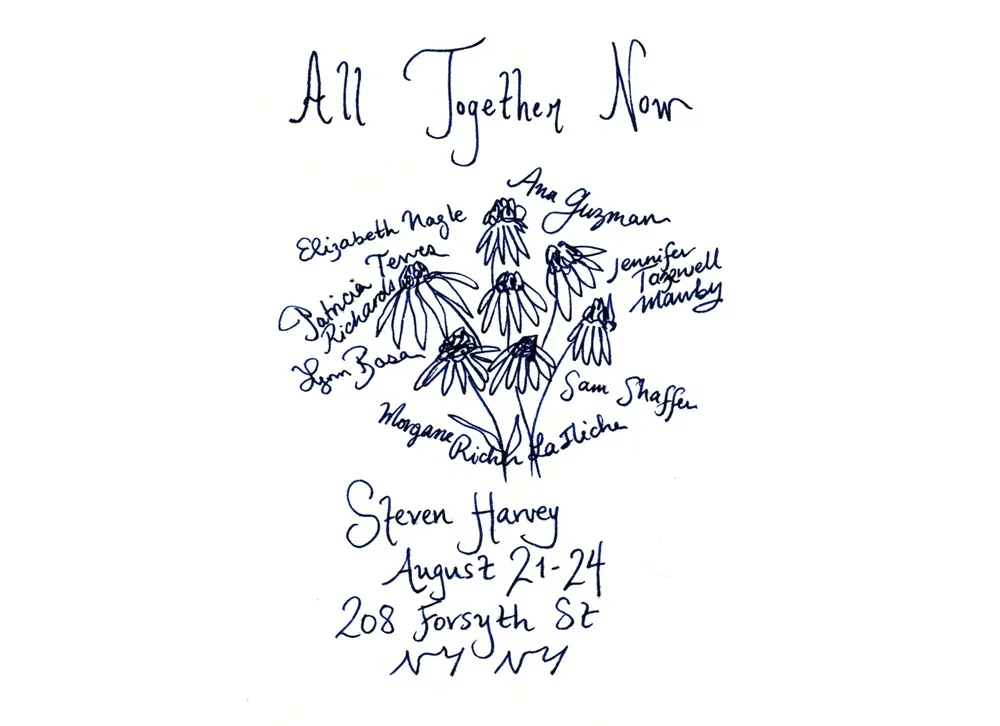
The Steven Harvey “mini” Symposia, co-led with Kyle Staver and Michael David, culminated in a dynamic pop-up exhibition and offered an unforgettable experience for painters and art lovers alike. First joining the Yellow Chair as a guest critic, Steven brought a truly spirited presence—an energy that sparked rich, animated conversations between the three, whose combined century of experience in looking at and loving painting created a unique and inspiring environment.

Each session closed with Steven reflecting on an artist he has exhibited, weaving personal stories and art history into intimate, thoughtful discussions. This fusion of storytelling, critique, and deep passion for painting made for an exhilarating format—a true hot house for personal and artistic growth.

A handwritten invitation titled 'All Together Now' with a drawing of a bouquet of daisies and names of people around the flowers. Includes details for an event: 'Steven Harvey, August 21-24, 208 Forsyth St, NY NY.'

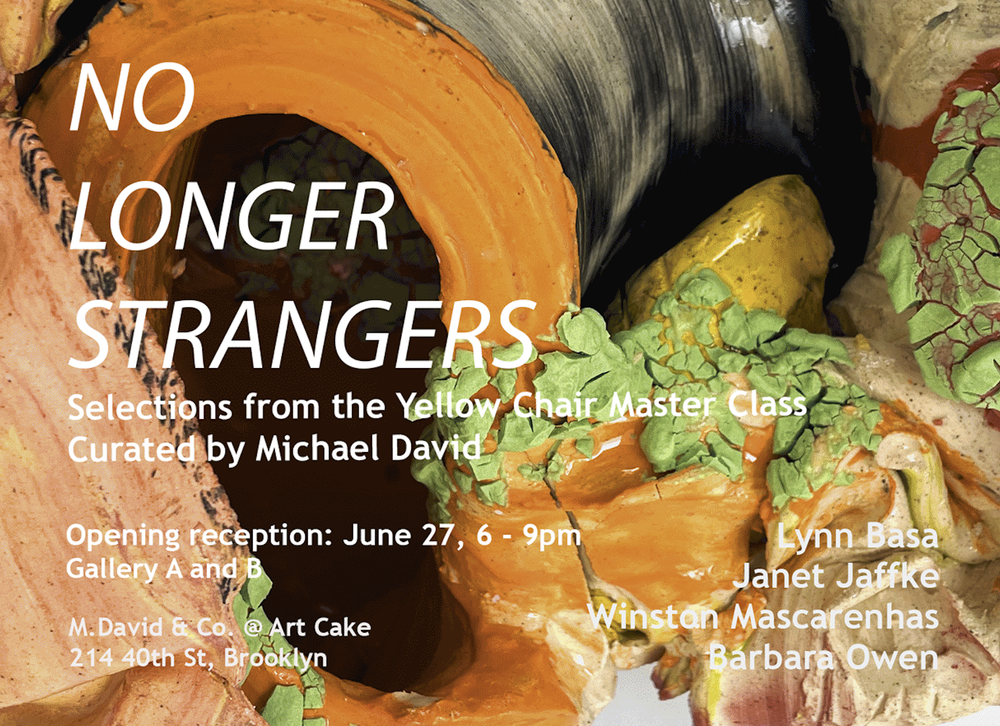
Text overlay on an artistic, colorful background of various painted and textured objects, reading 'No Longer Strangers, Selections from the Yellow Chair Master Class, Curated by Michael David, Opening reception: June 27, 6-9 pm, Gallery A and B, M. David & Co., 214 40th St, Brooklyn, Lynn Basa, Janet Jaffke, Winstan Mascarenhas, Barbara Owen.'

In June 2025, Art Cake hosted a dynamic four-week on-site Master Class program in its spectacular ground-floor space. Four carefully selected artists participated in an immersive and collaborative environment designed to foster dialogue, experimentation, and creative growth.

Throughout the residency, participants engaged with leading voices in the contemporary art world—prominent artists, critics, and gallerists—through studio visits, critiques, and informal conversations. The program provided unique behind-the-scenes access, including visits to the studios of renowned artists in both NYC and Upstate New York, as well as private tours and meetings with gallerists during active exhibitions.

The experience culminated in a public Exhibition and Artist Talk in Galleries A and B at Art Cake, showcasing the new work developed during the residency and offering audiences a window into the evolving practices of each artist.


Four artists Lynn Basa, Janet Jaffke, Winston Mascarenhas and Barbara Owen traveling from Chicago, France, New Mexico, and New Hampshire worked together for a month in the glorious spaces of Art Cake's galleries A and B.  This beautiful experiment resulted in bodies of amazing work that could have only happened in this space at this moment, at this time, with these four strangers coming together.  

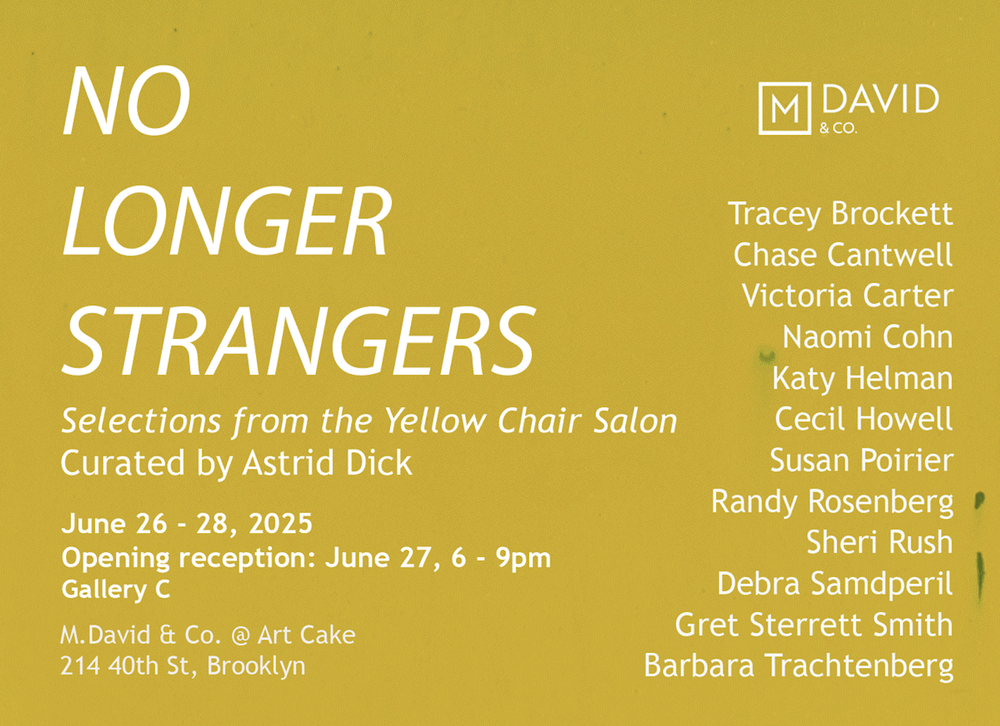
No Longer Strangers, is the title originally conceived by Astrid Dick to describe the pop-up exhibition running concurrently in gallery C, featuring the artists from her 2024 Spring Salon.

It became apparent the title perfectly embodied the sprit of the Yellow Chair Salon and both of these exhibitions.

No Longer Strangers is a celebration of conversations resulting from a coming together, virtually and on Tuesday nights, of twelve artists that joined Astrid Dick during the Spring of 2024 in the context of the Yellow Chair Salon. The importance of idiosyncrasy and the plurality of voices that may or not sing at once, or sing at all.  To contemplate the possibility that our own self may contain multitudes of strangers longing to meet.“ Astrid Dick

Exhibition poster with yellow background announcing "No Longer Strangers" from June 26 to 28, 2025, curated by Astrid Dick, with an opening reception on June 27 from 6 to 9 pm at Gallery C, Art Cake, Brooklyn. Includes list of artists' names and the M. David & Co. logo.

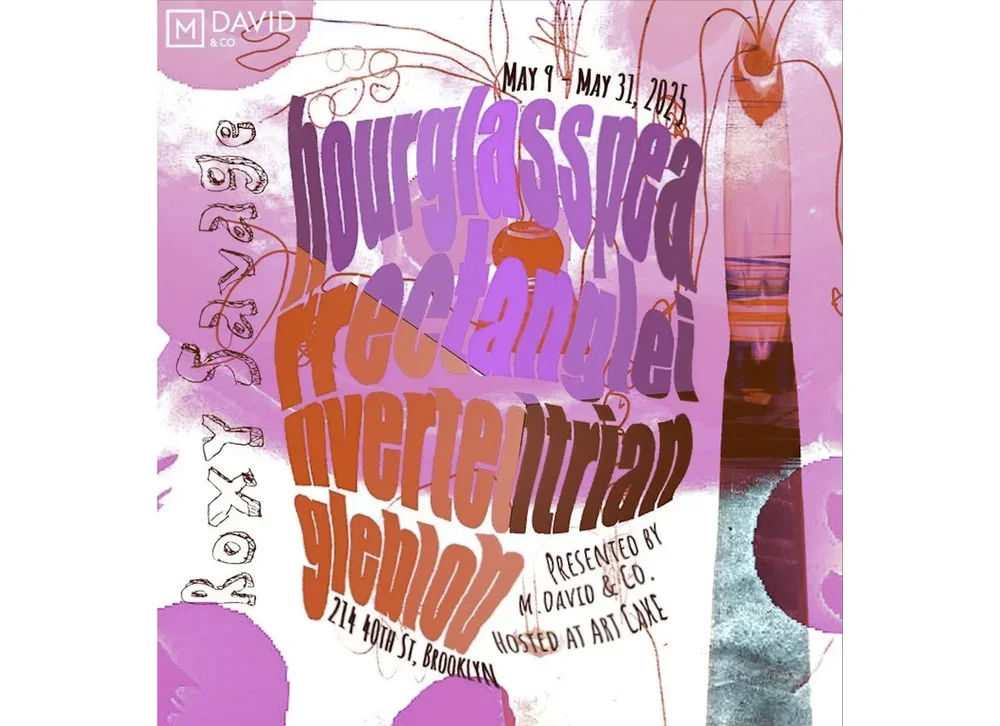
Colorful poster with abstract and artistic design, promoting the Brooklyn-based event 'Durational Sound Installation' from May 9 to May 31, 2023, hosted at Art Lane in Brooklyn, presented by M. David & Co.
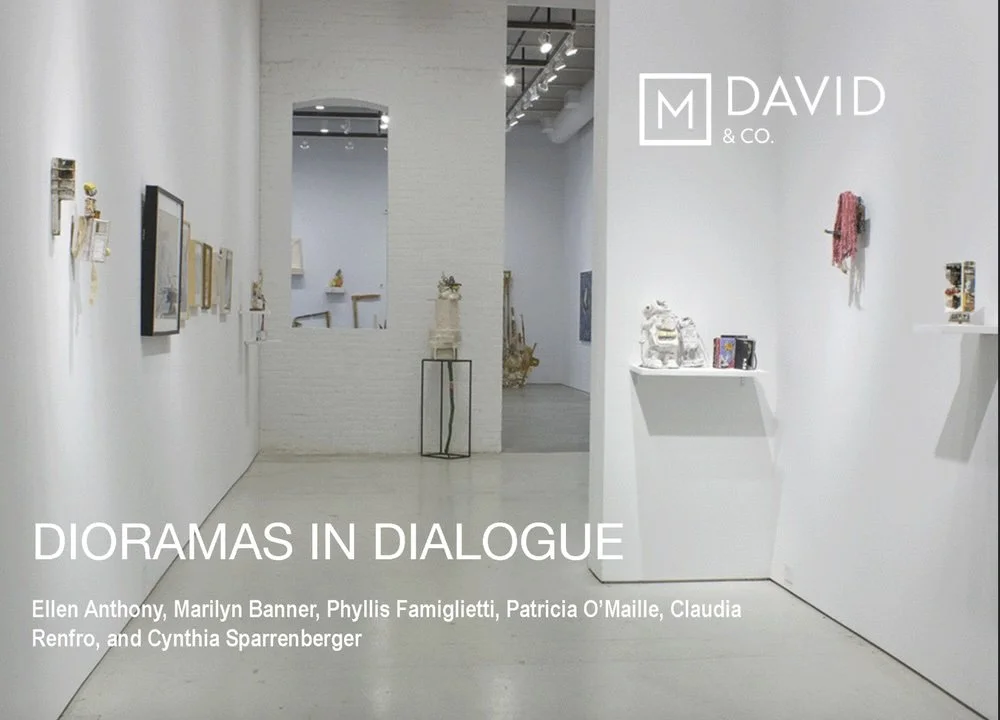
Interior view of an art gallery with white walls displaying various artworks and small sculptures, featuring the exhibition titled 'Dioramas in Dialogue'.

M. David & Co. is pleased to present Roxy Savage's installation in Gallery B entitled  hourglasspearrectangleinvertedtriangleblob. 

Featuring sheer, layered organza prints hung on the architecture of domesticity, a clothesline, the title references (and generalizes) and is an amalgamation of female body types, such as apple, pear, hourglass, rectangle, inverted triangle, V-shape, and blob.

This wild, merry (and not-so-merry) go-around of an installation's main character features a snowman (snowwoman/snow person) with a roundular female body type, which reveals itself as a series of personas, including friends, guests, twins, clowns, ghosts, and blondes.

Think of the love child of Frosty the Snowman and the Venus of Willendorf :)

Now sing along :)

  • Hourglass

    • Balanced proportions between bust and hips, with a narrower waist.

    • Often considered the "classic" feminine shape.

  • Pear (Triangle):

    • Hips are wider than the bust, with a well-defined waist.

    • The lower body is fuller, and the upper body is narrower.

  • Apple (Inverted Triangle):

    • Bust is larger than the hips, and the waist is less defined.

    • Weight tends to be carried around the stomach and upper body.

  • Rectangle (Straight):

    • Shoulders, waist, and hips have a similar width.

    • Minimal definition at the waist, creating a more uniform shape.

  • Inverted triangle:

    • Broad shoulders and a narrow waist and hips.

    • Typically an athletic build with more muscle definition in the upper body.

  • Athletic:

    • A more muscular body with less body fat and more definition, often with a straight silhouette.

  • Lollipop:

    • A larger bust with a smaller waist and hips, creating a top-heavy look. 

    • Spells .....Hourglasspearrectangleinvertedtriangleblob 

Savage's brilliance is her recontextualizing of these sexist definitions of the female form. Through the beauty and force of her production, she makes evident that each body type is unique, and that all body shapes are beautiful beyond the male gaze and its facile and dangerous characterizations and stereotypes.

So walk this wild labyrinth, this complicated, irregular network of passages and paths, to find one's way through this transformed space, the questions posed, this path of subversion, where righteous anger is whispered, made manifest through its mix of humor, grace, and delight, elevated and made most human.


Contradictions, dichotomies, counterpoints, and polarities imply instances of contrast, division, opposition, and dissimilarity. They point to notions of paradoxes and incongruities, and to ideas of variable distinctions pitched at distant extremities. 

All such circumstances are, in broad strokes, relational. While indicative of difference and disequilibrium, they can also be situated along lines of interconnectedness. To be fully understood, indeed, they must be. Their relativities entail placements on common spectrums or conveyance through shared mediums. There’s no counterbalancing, for example, without something on either side of some semblance of a balance. The counterpoint to a point only expresses its full significance if the point in question has been expressed sufficiently enough to be meaningfully countered. ‘This one here’ makes more demonstrative sense if there’s also a ‘that one there’. And back and forth, and vice-versa, and so on. 

Decoupled, these types of relationships become weakened or incoherent, or they fall apart entirely. Yet insofar as they remain coupled in some way, they cohere. Such coupled relativities of contrasting relationships, contradictory elements, and oppositional circumstances are an abiding source of inspiration for sculptor Lesley Bodzy. They inform how she selects and amalgamates various materials for her mixed-media sculptures, and they furnish conceptual grist to latch onto while contemplating formal qualities, palette choices, and process-related moves, and when determining if certain pieces have reached their moments of completion in states of subtly raw messiness or delicate finesse. Experimentation is of paramount importance to the artist, and she embraces it in ways that allow for planning and happenstance to come into procedurally active and readily visible confluence. 

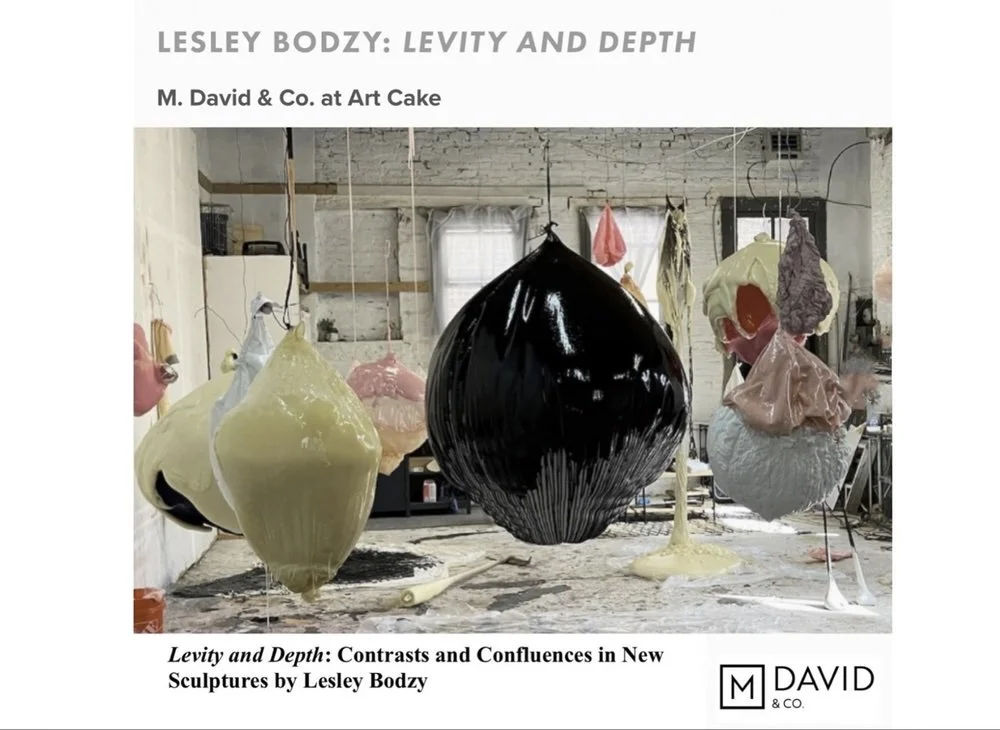
Multiple colorful abstract sculptures hanging in a bright art studio with white brick walls, windows, and art supplies, created by Lesley Bodzy.

Bodzy’s interests in material convergence and thematic divergence furnish the aesthetic backbone for Levity and Depth, the artist’s solo exhibition of new sculptures at M. David & Co. Gallery. Working in her studios in New York City and Houston, Bodzy has created a multivalent body of work conceived, for the purposes of the exhibition, as a large-scale, site-specific installation featuring, on the one hand, counterbalanced couplings of formally interconnected pieces and, on the other, counterpointing aggregations of autonomous objects. Arranged in various configurations from floor to ceiling, Bodzy’s curiously amorphous, bizarrely bulbous works hover and loom in her capacious workspaces, dangling around and sprawling about in an atmosphere of cavernous shadow-play, suspended kinetics, and ecstatic, somewhat sci-fi theatrics. Many of the hanging works feature balloons in variable states of full or partial inflation, or even impact-suggestive deflation, ostensibly the material consequence of subjection to pour-overs, sprays, drizzlings, and somewhat contained yet forceful dumpings of interactive materials such as resin, acrylic paint, and polyurethane foam. While materials such as these evidence a degree of chemical sameness given their shared essential properties as plastics, their existence in very differently inert or activated states at the moment of incorporation into the creative process – solids and pseudo-solids, liquids of various weights and viscosities, gaseous billows and expansions, stretchy elastics – ensure that they’ll react to, counteract, and interact with one another, catalyzing formal and material destabilization and metamorphosis before settling into place, balancing each other out, establishing a level of functionally stable equilibrium. Bodzy’s sculptures are thus the consequence and embodiment of all this pushing and pulling, inflating and deflating, eventually curing and cohering activity. Oppositional yet resolvable forces are captured in, laid bare by, and remain readily identifiable through the resulting works.

Rather less identifiable, however, is what these objects are, or what they might be intended to be. Their formal aspects register as both vaguely familiar and otherworldly. Their multivalent plastic-ness is plain enough, but they also seem to cosplay as various other material realities: ceramics, blown glass, organic curiosities, mineral deposits, extracted and preserved organs. For Bodzy, such elusive identifiability is the point. Most simply, the sculptures are what they are, or what they turned out to be, by dint of the instantiation and working-out of material processes. The artist’s aim is for the sculptures to serve as abstracted vessels of the themes of contradiction, paradox, and incongruity that inspire her, while also furnishing tangible attestation to the possibility of resolution. Bodzy seeks also to convey with them something of the mysteries of life and death, and the effects of time and aging on the body, as well as an array of related dualities: inhalation and exhalation, accretion and secretion, intention and chance, rawness and refinement, natural and artificial, beautiful and abject, sensual and unemotional, shiny polish and goopy mess. In palette and form alike, flesh-tone works such as Translucent Fragility, Instinctual Sciamachy, and Rancorous Glare appear to carry these themes with a sense of carnal vitality and apparent lightness, while larger, more formally complex and chromatically heavier pieces such as Diaphanous Nebula, Unsteady Contingency, and Multiplicitous Instances hint at these matters much more enigmatically, and with substantial weightiness and gravitas. The yields of so many reactive processes, interactive forces, and invasive interventions, Bodzy’s sculptures attain modes of enduring rest in states of deeply curious elegance. 

In Levity and Depth, Lesley Bodzy makes a prodigious display of counterpoints and distinctions, incongruities and divergences, and contrasts and differences. But she also makes plain that interconnections are inherent to such circumstances as well, and that resolution and equilibrium can be wholly plausible if not inevitable outcomes of resistive processes. In Bodzy’s sculptures, semantic and formal abstractions find expressive resolve through experimental actions and material interactions. Their curiously restful allure lures you into looking, and their deeply nuanced look lures you into lingering. 


Fantastical fabulations, dynamic figurations, delightful pastiches, soulful characterizations, material curiosities, narrative insinuations, and atmospheric theatrics of secret histories and escapist mysteries abound in Dioramas in Dialogue, a group showcase for Outsider Art Fair, presented by M. David & Co. Gallery, featuring new artworks by six contemporary artists: Marilyn Banner, Cynthia Sparrenberger, Ellen Anthony, Patricia O’Maille, Claudia Renfro, and Phyllis Famiglietti. Presenting their works in three collaborative pairs, these artists tell obliquely apparent yet distinctly compelling stories of joy and grief, life and loss, lessons learned and successes earned, and real-world struggles and dreamworld marvels. 

For all six artists in Dioramas in Dialogue, striking notes of formal variance by satisfying material curiosities experimentally is a paramount part of the process. It’s a manner of moving things forward in their studio practices without unraveling connective threads, a way to maintain consistency while reveling in the throes of creating something fresh. This entails working in a range of media, abstract formalities, and presentational modes – all crucial not merely for practical purposes, but insofar as it serves as a prolific source of inspiration as well. Such an approach is iterative yet not repetitive, and one that demonstrates imaginative freedom, creative determination, and expressive continuity in equal measure.

These artists’ practices are as rooted in confidence and intention as they are in experimentation and impulse – the traits that stoke the burn that fuels the churn. For this group of seasoned makers, their common creative recipe is tried and true: Know what you’re cooking. Never cook it the same way twice. Remix ingredients and methods. And remember there’s always a novel way to cook it up – or something new to cook altogether. 

It’s not a recipe these artists arrived at overnight. As is the case for many artists, it’s an exploratory ethos that results from a mixed bag of creative experiences – from a lifetime of working instinctively and by trial and error, to mentoring and training inside and outside of institutional settings, to developing skills honed through various personal and professional pursuits that eventually make their way into artistic expression in the studio, especially once it’s possible for a devoted studio practice to become a primary focus. This same mixed bag of experiences is also one that, for some artists – despite how genuinely enriching such a nonlinear creative background can be – might nonetheless lead to limited exhibition opportunities or exposure in the art world, particularly when one’s artistic practice is held in check by family life and family loss, personal and interpersonal tribulations, and variable modes or extended periods of social or geographical isolation. Pursuing a professional path as an artist is ridden with circumstantial challenges even without so many additional limitations, so the sum total can amount to quite a lot to overcome. Nurturing material enthusiasms, however, and staying active in the studio by staying actively curious, can make many such real limitations seem immaterial. 

It’s no surprise then that the artists in Dioramas in Dialogue, given their common ground in mixed-bag artistic recipes and diversified, at times challenging creative backgrounds, operate within a shared sphere of assorted, bountifully expressive abstract aesthetics and narrative thematics. These characteristics are readily identifiable for each artist individually and for the group of six as a whole, and they come into particularly delightful, formally complementary focus through the collaborative installations they’ve developed by working in pairs. To this end, the artists’ aim was to convey a sense of shared staging, dioramic interplay, and implicit dialogue among their works. Hence Marilyn Banner’s profoundly spirited, loosely delineated figurations on richly textured raw surfaces, casually accented with loosened threads splayed out at the fringes, alongside Cynthia Sparrenberger’s charismatic sculptural characters, including a sassy rabbit strutting along like a tiny giant storming onto the scene, with a cheerfully defiant gait, from an unseen land of make-believe at stage left. Hence, too, Ellen Anthony’s rustically charming, theatrically charged bricolage sculptures perched and dangling, as if idling in wait in an obscure puppet master’s secret workshop, among Patricia O’Maille’s nimbly rendered, soulfully folkloric, storybook-suggestive apparitions that seem to have emerged wholesale, with human and avian likenesses, onto vintage-like papers from some mystical ether. And hence, as well, Claudia Renfro’s deftly embroidered, colorfully embellished, fabulously animated tableaus of cartoonish figurations fantastically rejoicing in whimsical reverie, parading around next to Phyllis Famiglietti’s painstakingly assembled, sympathetically amusing composite sculptures that scan as humbly engineered toys or elemental automatons discovered on the tool-cluttered workbench of an inspired tinkerer. 

The artworks in Dioramas in Dialogue inhabit a world of intrigue, imagination, and mystery where the preciousness of life and fundamentality of fun have been lost on no one. It’s a place where quieted acoustics whisper variable narratives that present as visually vociferous, even raucous. In this collaborative exhibit, the artworks on display are in contextual dialogue with one another while speaking to viewers individually, jointly, and collectively, with an array of potential narratives lingering among them. Some such stories are hinted at by the artists themselves in their artworks’ titles, as well as in the rich and insightful reflections they composed about one another’s works on occasion of this special show. There’s a lot to explore and interpret in Dioramas in Dialogue, and a lot to relish. Unambiguous throughout is that harnessing the creative spark of joy – a long-sought, hard-fought-for, and hard-won recipe for success – is an indispensable part of the artistic process.


Exhibition wall titled 'LIMBLISS' with two contemporary art pieces, one resembling a wrinkled fabric dress on the floor and a mixed-media abstract wall sculpture on the right, featuring blue and black elements. Text mentions the event is from December 6 to December 28, 2024, at David & Co. with artists Lesley Bodzy, Robin Dintiman, Ginnie Peterson, Francesca Schwartz, and Sam Shaffer.

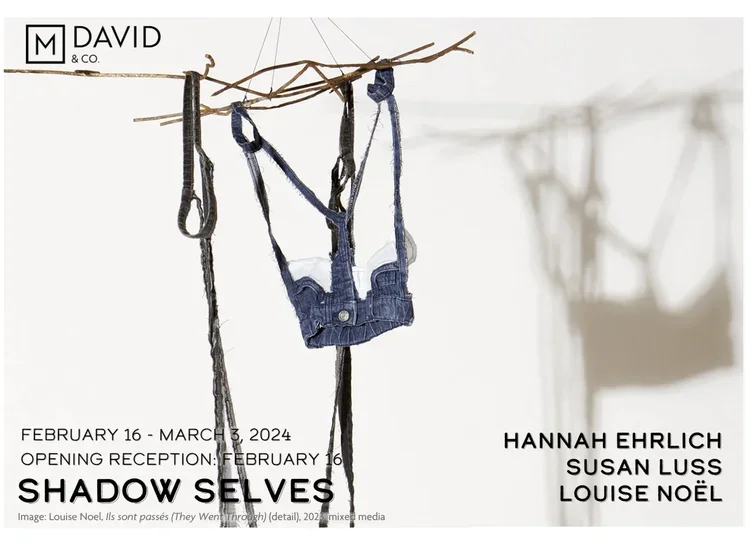
Just as shadows themselves can manifest in manifold ways according to shifting circumstances, so too can expressions of, and understandings gained through, shadow selves. Such aspects of self might be those we conceal or obscure in order to shroud them in secrecy. They might be matters we strive to unknow or bury through modes of suppression. They might be memories or characteristics we acknowledge as extant, yet consider to be of secondary importance or presence – as impressions of things we bear in mind, or impressions we believe to have left behind. Our shadow selves might also be those we come to terms with, over time, by sharpening our senses of self-awareness, or by simply becoming more comfortable in our own skin. This might entail recognizing an interdependent rapport between our objective realities and how we shed light upon them, alter their forms, trace their contours, construe them for what they are, or try to illuminate them in revelatory ways through modes of cognitive, or perhaps artistic, abstraction. 

The featured artists in Shadow Selves – Susan Luss, Hannah Ehrlich, and Louise Noël – bring all such concerns to bear in this tightly curated exhibition of assemblage sculptures, site-specific installations, and works on paper. Working in a range of media yet within a markedly kindred aesthetic, these artists take into consideration craft traditions and labor norms; notions of self as contained by and refracted through the body; the layered histories of objects and materials, especially through acts of upcycling, alteration, and repurposing; and variable expressions of corporeality and female agency.

Luss, Ehrlich, and Noël position themselves as active conduits of familial histories, childhood memories, personal experiences, contemporary social and political issues, and variably inflected visions of the future, and they channel these diverse themes into their art. The creative selves they carry into their work become marks made, forms configured, figures hidden and found, gestures transposed, and energies transferred. As such, the visual yields of these processes of transference are where their notions of self emerge, cohere, and come to the fore. Rather than hiding, or hiding from, their shadow selves, these artists opt to embrace, collaborate with, and learn from them – and to convey traces of them to receptive viewers. 

This sense of collaboration is of paramount importance for all three artists. Theirs is a metaphorical understanding of the term; they interpret it as a practice of collaboration not with other artists to make artwork, but as a collaborative mindset in their relationship with their operative materials, concepts, and circumstances. Rather than merely implementing these things in their work, they imagine themselves engaging with, acting through, and working alongside them. For Susan Luss, collaboration entails working with light, surfaces, an array of liquid media, various types of mark-making techniques, and all manner of fluctuating spatial considerations in the creation of colorful, large-scale textile installations. In As Above, So Below, a sprawling horizontal work designed with site-specific alterability in mind, the artist’s chromatic muse is a range of mostly deep blues, and her expansive, gesturally restive marks are circular, radial, astral, loosely linear, dispersive, and constellational. Surface texture, ambient light, and formal interruptions become crucial aspects of this immersive work’s visual experience through the artist’s carefully considered deployment of drapery, pleating, and folds, such that the shadows resulting from registers of relief become linear interventions in their own right – linearities of variable lightnesses and depths, all consistently subject to change according to transient luminosities. Luss considers her body and the canvas to be one and the same while working, the latter ostensibly molding around the former before emerging as a form of its own. The yields of these multifarious processes here, from the making of marks to the metaphorically molded forms, present as a mysteriously rendered map of the night sky – a vast diffusion of nebular dusts settling into place according to some unknowable force of cosmic ordering. 

Relief shadows, limited palettes, site-specificity, large scales, and a collaborative relationship with surfaces and materials are key concerns for Hannah Ehrlich as well. Working with repurposed doilies to create somewhat gently imposing, organically expansive sculptural installations that crawl up, down, all along, and off of walls, sometimes meandering down and out to creep along floors as well, Ehrlich imagines her artwork to be a collaboration with history, too, and tradition – a sense of collaboration that means working with, but also reworking, working through, and working against. In Never Alone: Accompanied by Grief, the artist seeks to extract beauty from the shadowy depths of a dolorous spectrum of emotive experience. Ehrlich dips individual doilies in black gesso and mounts them together – one at a time into sections, then one section at a time into broadened extensions – resulting in elegantly amorphous outgrowths that appear to proliferate as biomorphically multicellular units, pulsating insistently with enigmatic vitality. And yet, given their pitch-like aspect, these vacillating units also seem to mark the waning or vestiges of life. The artist incorporates other black-gessoed materials into the doily structure as well, while also suturing selected areas together with a free-flowing, non-conforming, rule-breaking crochet technique. For Ehrlich, repurposing doilies and reinterpreting crochet, both emblematic of a vast array of weaving histories, are tantamount to reclaiming craft traditions materially while undermining or reforming them conceptually – deploying very differently, even proactively exploiting a questionable index of femininity by reappropriating and reconfiguring it from the ground up. 

While Louise Noël shares many of the same conceptual concerns and ideas of material collaboration with Ehrlich and Luss, her relationship to scale, expressive registers, and implicit references to corporeality are quite different. Noël’s series of assemblage sculptures collectively titled Je ne connais pas son nom (I Do Not Know Their Name) are utterly spare, skeletally present, and delicately displayed – hanging lightly from the ceiling, as if incidentally, or dangling openly before walls, as if drying out. Indeed, an image of makeshift clotheslines here is not inapplicable, as Noël’s source materials are unmistakably aged, wholly reconfigured, nimbly repurposed articles of clothing. The artist’s use of previously owned garments is a cultivated choice. For her, these items have not only been owned and used by others – and unknown others, at that – but they have also covered those others’ bodies in one way or another, adorning or even protecting them, taking on their forms and contours, perhaps even preserving traces of their oils in their fibers. As such, these garments carry forth something of their previous owners’ identity even in their owners’ absence – material shells as shadow selves, auratic manifestations of disembodied otherness. Noël works meticulously to turn blouses and other pieces into peacefully ghostlike presences that scan as line drawings both materially and immaterially – the remnant linearity of the material of the articles of clothing, and the shiftily linear suggestiveness of the shadows they cast. Noël collaborates with the garments’ histories and, at a remove, with the garments’ erstwhile owners to breathe new life into items that have fallen into disuse. Consequently, the pieces themselves, no longer fallen but raised into space, collaborate with the shadows they cast to flesh out and enhance one another’s salient attributes. The spareness of form and senses of silhouette-like, shadowy substantiality inherent to Noël’s assemblages are palpable in her scrupulously crafted works on paper as well, in which rich, intuitively applied washes of walnut ink appear patently abstract yet innately figurative. 

In Shadow Selves, senses of self, senses of others’ selves, and senses of othered selves come into material confluence. As evidenced by their works in this carefully curated show, Susan Luss, Hannah Ehrlich, and Louise Noël employ and collaborate with shadows both real and metaphorical to suggest the presence of bodies where bodies no longer are, and to illuminate lingering traces of histories that were – and that might yet, in reconfigured forms, endure. Shadowy aspects of self might be held in secret, suppressed, or obscured. Yet they might also be channeled into artworks to free them from the shade of confinement – releasing them into the world to cast revelatory light on life.


Empty art gallery with white walls, decorated with colorful wall art, sculptures, and a small white stand. Natural light creates shadows on the wooden floor.